


Government Job Oriented Junior Mechanic Hydraulic Training with Certificate and Skill India

A hydraulic machine does not fail politely. A small oil leak, weak pressure, wrong seal, clogged filter, or faulty hose can stop an excavator, tractor attachment, loader, press machine, crane, lift, or industrial power pack within minutes. That is why trained hydraulic mechanics are needed in workshops, plants, service centres, construction sites, rail-related maintenance units, public works departments, defence support services, and many other technical workplaces.
For learners who want a practical trade with government job relevance, Junior Mechanic Hydraulic training can be a strong starting point. It builds hands-on knowledge of hydraulic systems, safety, servicing, fault finding, and basic repair work. When the training includes a recognised certificate connected with Skill India standards, it also helps learners present their skills in a more organised and credible way during job applications, apprenticeships, interviews, and skill assessments.
The focus of a Government Job Oriented Junior Mechanic Hydraulic Training with Certificate and Skill India programme at GrowUpSkill.com should be simple: learn the trade in a practical way, understand how hydraulic machines work, and prepare for technical roles where maintenance skills matter.

Why hydraulic mechanic training matters for government job preparation
Government and public sector technical roles often require more than book knowledge. Many posts in maintenance, plant operation support, workshop assistance, equipment repair, and technician categories involve real machines. Candidates who understand mechanical systems, tools, safety, and troubleshooting usually feel more confident during trade tests and interviews.
Hydraulics is used across many sectors in India:
Earthmoving and road construction equipment
Agricultural machinery and attachments
Industrial presses and lifting systems
Material handling equipment
Railway workshop machinery
Mining and heavy equipment support
Irrigation and public works machinery
Defence and transport maintenance support units
A junior mechanic does not start by handling every complex repair alone. The role usually begins with assisting senior technicians, checking oil levels, replacing filters, identifying leakage points, tightening fittings, cleaning components, reading basic diagrams, and supporting preventive maintenance. With practice, the mechanic learns to diagnose pump issues, valve problems, cylinder faults, pressure loss, overheating, and contamination.
This is where structured training helps. A learner who only watches repairs in a local garage may pick up shortcuts, but might miss the basic science. A learner who studies only theory may understand pressure and flow, but struggle when a hose bursts or a cylinder seal fails. A good course combines both.
For government job preparation, this balance is valuable because selection stages may test:
Basic technical understanding
Tool identification
Safety awareness
Trade terminology
Workshop discipline
Fault diagnosis approach
Practical handling of parts and systems
A certificate does not replace skill. It supports skill by showing that training has been completed in an organised format. The real advantage comes when the learner can explain and demonstrate the work.
What a Junior Mechanic Hydraulic course should teach
Hydraulic training should begin with the basics, then move towards servicing and fault finding. The best learning path is practical, step by step, and connected to real machines.
Hydraulic fundamentals
Every learner should understand the core idea of hydraulics: fluid under pressure can transfer force. This simple concept is used to lift heavy loads, move cylinders, operate attachments, press materials, and control machine movement.
Important concepts include:
Pressure, flow, force, and speed
Hydraulic oil function
Directional control
Load holding
Heat generation
Contamination control
Safe release of pressure
These basics help learners avoid guesswork. For example, a slow cylinder movement may not always mean a damaged cylinder. It could be low flow, clogged filter, worn pump, internal leakage, incorrect oil grade, or restricted hose.
Hydraulic components
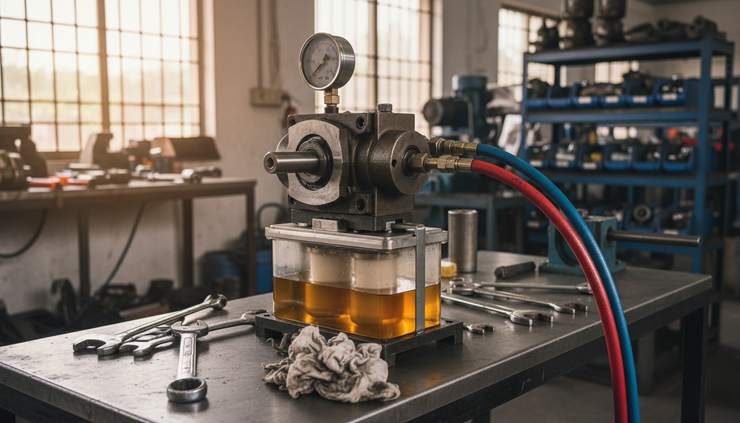
A junior mechanic should be able to identify common parts and understand what each one does. These include:
Hydraulic pump
Reservoir or tank
Suction line and return line
Pressure hose
Control valve
Relief valve
Cylinder
Motor
Filter
Seals and O-rings
Couplings and fittings
Pressure gauge
Component knowledge makes troubleshooting easier. If a trainee knows where oil enters, where pressure builds, and where movement happens, the system becomes less confusing.
Tools and workshop practice
Hydraulic work needs careful handling. A bad fitting, wrong spanner, dirty oil container, or damaged seal can create bigger problems. Training should include normal workshop habits such as tool selection, cleaning, marking, basic measurement, safe lifting, and correct assembly.
Learners should practise with:
Spanners and socket sets
Hose crimping awareness
Pressure gauges
Seal pick tools
Cleaning trays
Torque basics
Oil handling containers
Personal protective equipment
The goal is not to memorise tools. The goal is to use them safely and correctly.
The role of Skill India certification
Skill India has helped bring more attention to job-ready vocational training across the country. For trades such as hydraulics, welding, electrical work, fitting, machine operation, and maintenance, skill-based learning is often more useful than purely academic study.
A certificate linked with Skill India standards can help learners in several ways:
It gives structure to the training
It helps show completion of a skill course
It can support applications for technician and apprentice roles
It gives learners a clear trade identity
It can help during interviews where proof of training is requested
Learners should always check the certificate details before enrolling. A responsible training provider should explain who issues the certificate, what the course covers, whether assessment is included, and how the certificate can be verified if required.
This is especially important for government job aspirants. Recruitment bodies may have specific eligibility rules. Some posts may ask for ITI, diploma, apprenticeship, experience, or a certificate from a recognised body. Others may allow equivalent skill training. The right approach is to read the latest official notification for each vacancy and match the certificate with the stated requirement.
A Skill India-linked certificate can support preparation, but it should not be treated as a guarantee of selection. Government jobs depend on eligibility, written exams, trade tests, document verification, category rules, age limits, vacancies, and merit.
The value of training is still real. It helps learners build practical ability, which can be useful for government jobs, private jobs, contract maintenance work, apprenticeships, and self-employment.
How GrowUpSkill.com can support job-oriented learning
GrowUpSkill.com can be useful when the training is designed around practical outcomes rather than only video lectures or notes. A learner preparing for technical employment needs clear modules, trade-focused lessons, practice guidance, assessments, and certificate support.
For Junior Mechanic Hydraulic training, the learning experience should include:
Simple explanations of hydraulic principles
Visual understanding of parts and assemblies
Safety instructions for pressure systems
Fault examples from real maintenance work
Basic servicing procedures
Course completion certificate support
Guidance for job-oriented preparation
A good online or blended course should not pretend that a learner can become an expert only by watching content. Hydraulics is a practical trade. The course should encourage practice, tool familiarity, observation in workshops where possible, and revision of diagrams and component functions.
For learners in small towns or villages, online training can still create a strong base. Many candidates do not have easy access to a full hydraulic lab. They can start by learning concepts, system layouts, safety rules, and diagnostic methods. Then they can seek workshop exposure, apprenticeship opportunities, or practical training sessions to build hand skill.
For learners already working in garages, agricultural machinery service, JCB or excavator repair support, tractor workshops, or industrial maintenance, a structured course can fill knowledge gaps. It can turn experience into a clearer skill profile.
The biggest benefit is direction. Instead of randomly learning from scattered sources, a job-oriented course shows what to study first, what to practise, and how to speak about the trade during interviews.

Skills that can improve employability
A junior mechanic’s strength is not only in repairing parts. Employers and government workshops value safe, disciplined, and reliable workers. Training should build the full work habit.
Safety awareness
Hydraulic systems can store high pressure. Unsafe handling can cause oil injection injuries, burns, slipping hazards, or sudden movement of machine parts. A trainee must learn to release pressure, isolate equipment, support raised loads, wear eye protection, and avoid checking leaks with bare hands.
Fault finding
Good mechanics do not replace parts blindly. They observe symptoms, ask what changed, check oil condition, inspect hoses, listen for pump noise, read pressure, and test step by step.
Common faults include:
External oil leakage
Slow cylinder movement
Jerky operation
Low pressure
Overheating
Noisy pump
Foaming oil
Filter choking
Seal failure
Weak lifting power
Maintenance discipline
Preventive maintenance reduces breakdowns. A junior mechanic should know how to check oil level, inspect hose condition, clean breathers, replace filters, tighten loose fittings, and report abnormal noise or heat early.
Communication and reporting
In many government and public sector workplaces, record keeping matters. A mechanic may need to report what was checked, what part was replaced, and what fault was found. Clear reporting saves time and prevents repeat breakdowns.
Readiness for trade tests
Candidates preparing for technical recruitment should practise basic trade questions. They should be able to identify symbols, name components, describe safety steps, and explain common faults in simple language.
For example, if asked why a hydraulic system overheats, a prepared candidate can mention low oil level, wrong oil, blocked filter, worn pump, relief valve setting, continuous overloading, or poor cooling. That answer shows understanding.
Career paths after Junior Mechanic Hydraulic training
Hydraulic training can open several entry-level paths. The exact opportunity depends on education, experience, location, vacancy requirements, and practical skill level.
Possible roles include:
Junior hydraulic mechanic
Maintenance helper
Workshop assistant
Equipment service assistant
Earthmoving machinery service trainee
Hydraulic fitter helper
Plant maintenance support worker
Apprentice technician
Field service support assistant
Government-related opportunities may appear in departments or organisations that maintain machinery, vehicles, plants, construction equipment, irrigation systems, transport equipment, or workshop facilities. Candidates should regularly check official recruitment notifications and employment portals. They should also track apprenticeship openings, skill development notices, and technical helper posts.
Private sector work can also be a strong stepping stone. Experience in a service centre, equipment rental company, hydraulic hose workshop, tractor implement workshop, industrial maintenance team, or construction machinery repair unit can help build confidence. With experience, a learner may move towards senior mechanic, service technician, field technician, supervisor, or small workshop ownership.
A certificate can help at the entry point, but growth will depend on work quality. The best mechanics keep learning. They study new machines, ask why failures happen, maintain clean work habits, and avoid unsafe shortcuts.

How to choose the right hydraulic training programme
Before enrolling in any course, check whether it matches the goal. A job-oriented course should be clear, practical, and honest about outcomes.
Look for these points:
Course syllabus with hydraulic basics and servicing topics
Clear certificate information
Skill India connection or certification route explained properly
Practical examples, not only theory
Safety training included
Assessment or practice checks
Support for interview and trade test preparation
Simple language and repeatable lessons
Guidance for next steps after course completion
Avoid choosing only by low fees or big job promises. No training provider can honestly guarantee a government job. A good provider can prepare learners better, explain the trade, provide certification support, and guide them towards opportunities.
Also keep personal eligibility in mind. Many government posts have educational requirements. If a vacancy asks for ITI or diploma, a short certificate course may not replace it unless the notification allows it. Read official job advertisements carefully.
The right mindset is to treat training as a skill base. It can support government job preparation, but it can also help in private employment and practical workshop work.
A practical trade with long-term value
Hydraulic systems will remain important wherever heavy force, lifting, pressing, steering, and controlled movement are needed. India’s construction, agriculture, manufacturing, transport, mining, and public works sectors all depend on machines that use hydraulics.
That creates a steady need for people who can maintain equipment responsibly. A learner who completes Junior Mechanic Hydraulic training with certificate support through GrowUpSkill.com can build a useful foundation for technical work. The certificate helps show preparation. The real strength comes from understanding systems, practising safely, and developing fault-finding confidence.
For government job aspirants, this training can be part of a wider plan: study the official syllabus, improve trade knowledge, practise practical questions, keep documents ready, and apply only after checking eligibility. For working learners, it can improve current workshop skills and create a clearer path towards better roles.
Hydraulic repair rewards patience. The mechanic who stays clean, safe, and systematic often finds the fault faster than the one who only guesses. That is the habit a good job-oriented training programme should build.


Comments