


Skill India Concrete Pump Operator Training for Government Jobs Skills Safety and Success Stories

India’s roads, bridges, metros, flyovers, irrigation works, public housing projects, and industrial corridors all need one thing in common: skilled people who can work safely with heavy construction equipment. Among these roles, the concrete pump operator has become especially valuable because modern construction depends on speed, accuracy, and safe concrete placement.
The Skill India Concrete Pump Operator Training program gives learners a practical route into this field. It does more than teach machine handling. It builds job-ready skills, safety discipline, site awareness, and confidence, all of which matter when applying for government-linked opportunities, public infrastructure projects, and contractor roles serving government departments.
For many trainees, this is not just a short course. It can be the first step towards stable work, recognised skills, and a career in India’s growing infrastructure sector.
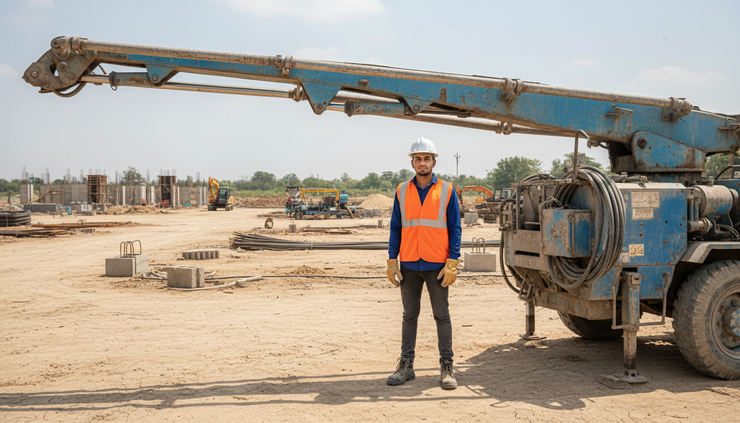
Why concrete pump operator training matters for government job opportunities
Government jobs and government-linked construction work are often highly competitive. Candidates with only general labour experience may struggle to stand out. A recognised skill certificate can make a real difference because it shows that the person has been trained for a defined role.
Concrete pump operators are needed across many public works and infrastructure activities, including:
Road and highway construction
Metro rail and railway projects
Government housing schemes
Bridge and flyover work
Irrigation and canal projects
Public building construction
Smart city and urban development projects
Not every role will be a direct permanent government post. Many opportunities come through contractors, public sector project sites, municipal works, state infrastructure agencies, and government-approved construction projects. Even in such cases, trained operators are preferred because the work involves expensive equipment, tight deadlines, and serious safety risks.
A candidate with training can show that they understand:
How concrete pumping equipment works
How to follow site safety rules
How to communicate with supervisors and workers
How to reduce machine breakdowns and wastage
How to handle pressure during concrete pouring
This matters because construction sites cannot afford repeated errors. A delay during concrete placement can affect quality, cost, and worker safety. Skilled operators help keep the job moving.
What the training usually covers
Concrete pump operator training is practical by nature. A good program does not rely only on classroom teaching. It combines theory, demonstrations, supervised practice, and assessment.
The exact course content may vary by training centre, equipment type, and certification structure. Still, most quality programs focus on the same core areas.
Training area | What learners gain |
Machine basics | Understanding the concrete pump, hopper, boom or pipeline, valves, pistons, controls, and power systems |
Concrete behaviour | Learning how concrete mix, slump, flow, and setting time affect pumping |
Site preparation | Checking ground conditions, approach routes, pipeline layout, and safe working space |
Pump operation | Starting, stopping, controlling pressure, monitoring flow, and handling blockages |
Safety practice | Using PPE, following signals, managing hazards, and preventing accidents |
Maintenance | Cleaning, greasing, routine checks, and reporting faults |
Communication | Coordinating with batching plant staff, supervisors, masons, and safety teams |
Emergency response | Knowing what to do during hose whip, high pressure, machine failure, or concrete blockage |
The aim is simple: the trainee should be able to work under supervision at first, then grow into an independent operator with site experience.
Safety skills are the backbone of the program
Concrete pumping looks straightforward from a distance. On site, it is a high-responsibility task. The machine works under pressure. The hose can move suddenly. Concrete can block inside the pipeline. Workers may stand too close. Electrical lines, weak ground, poor communication, or careless cleaning can create serious danger.
That is why safety training is not a side topic. It is central to the role.
A trained concrete pump operator learns to check the work area before starting. This includes looking at ground stability, nearby workers, overhead lines, access for transit mixers, and the position of the pump. The operator must also confirm that pipelines, clamps, bends, and hoses are fitted correctly.
Common safety practices include:
Wearing a helmet, gloves, safety shoes, reflective jacket, and eye protection
Keeping unauthorised workers away from the pump and hose
Checking clamps, seals, pipes, and couplings before pumping
Avoiding sudden pressure changes
Never opening pipes while under pressure
Cleaning the machine only after safe shutdown
Following hand signals or agreed communication methods
Reporting unusual vibration, leakage, noise, or pressure changes
A good operator does not only move concrete. A good operator protects people, equipment, time, and project quality.
This safety-first mindset is one reason trained candidates are valued on government project sites. Public works are closely monitored, and contractors are expected to maintain safety standards. A certified, disciplined operator reduces risk for everyone involved.

Operational techniques that make trainees job-ready
A concrete pump operator needs more than basic machine knowledge. The person must understand timing, pressure, flow, and team coordination. Every pour is different. A slab, column, bridge deck, retaining wall, and high-rise floor each demand a different approach.
Training helps learners practise important operational techniques such as:
Reading the site before pumping
Before work begins, the operator studies where the pump will stand, where the concrete will go, and how workers will move around the area. Poor positioning can slow down the pour or create danger.
Managing concrete flow
Concrete must move smoothly through the line. If the mix is too dry, too wet, delayed, or poorly graded, pumping becomes difficult. Operators learn how to watch the flow and alert the supervisor if the mix appears unsuitable.
Handling pressure correctly
Pressure is useful, but uncontrolled pressure is dangerous. Trainees learn to avoid sudden force, recognise abnormal pressure build-up, and stop safely when needed.
Preventing and clearing blockages
Blockages are common in concrete pumping. A skilled operator knows the warning signs, such as reduced flow, unusual pump sound, or pressure rise. Training teaches safe methods to respond without putting workers at risk.
Cleaning after operation
Cleaning is a major part of the job. Leftover concrete can harden inside the system and damage equipment. Trainees learn proper cleaning steps, waste handling, and inspection after use.
These techniques directly affect employability. A site manager may teach small local practices, but they prefer a candidate who already understands the fundamentals.
How the training improves confidence during selection
Many government-linked construction roles require proof of skill, practical ability, and discipline. A training certificate alone may not guarantee a job, but it can support the application in several ways.
It helps candidates:
Show role-specific knowledge during interviews
Perform better in practical trade tests
Understand safety questions asked by recruiters
Apply for contractor and project-based roles with more confidence
Build a profile for future upskilling in heavy equipment operation
For candidates from rural areas, small towns, or informal labour backgrounds, Skill India training can also help convert experience into recognised ability. Someone who has worked near construction equipment for years may still be treated as untrained if there is no certificate. Training gives structure to that experience.
It also supports mobility. A trained worker may find opportunities outside the home district, especially where large infrastructure projects are active. States with metro expansion, road upgrades, industrial development, and urban housing works often need skilled construction equipment operators.

Success stories that show what this path can offer
The following stories are representative examples based on common training and employment journeys in the construction sector. Names have been changed, but the situations reflect realistic paths for trained workers.
Ramesh moved from helper work to machine operation
Ramesh started as a construction helper in a small town in Uttar Pradesh. His work was irregular. Some months were good, others were difficult. He often stood near concrete pouring work but never handled the pump because he had no formal training.
After joining a Skill India-linked concrete pump operator course, he learnt machine parts, PPE rules, pipeline handling, and safe cleaning. The most useful part for him was learning how to recognise pressure build-up before a blockage became dangerous.
After training, he joined a contractor working on a public road project. He did not become the main operator on day one. He started as an assistant operator, but his certificate helped him get selected. Within months, he was trusted with more responsibility because he followed safety steps and asked the right questions.
His biggest change was not only income. It was identity. He was no longer seen as a casual helper. He had a trade.
Shabnam entered a field many people did not expect her to choose
Shabnam came from a family where most people believed construction equipment work was only for men. She had completed school but did not want a desk-based course. She wanted a practical skill with earning potential.
During training, she first struggled with machine controls and site signals. With practice, she became confident in pre-operation checks, communication, and cleaning routines. Her trainers encouraged her to focus on precision and safety, not physical strength alone.
She later found work with a contractor engaged in government building projects. At first, some workers were surprised to see her near the pump. Her discipline changed their view. She prepared checklists, maintained her PPE, and stayed calm during concrete pours.
Her story shows that skill-based construction careers can be open to anyone willing to train seriously and work safely.
Imran used training to return to work after a job gap
Imran had worked in informal construction jobs in Maharashtra, then returned home for family reasons. When he tried to re-enter the workforce, he found that younger workers were being preferred for general labour roles.
He chose concrete pump operator training because it offered a defined skill. The course helped him refresh site basics and learn new safety practices. He also learnt how maintenance records and daily machine checks matter on large projects.
After completing training, he applied to contractors involved in public infrastructure work. His previous site experience, combined with new certification, helped him stand out. He was hired for a project-based role and later became part of a regular equipment team.
For workers with gaps in employment, training can rebuild confidence and show employers that they are ready for current site standards.
What makes a good concrete pump operator
Machines are important, but attitude matters just as much. Government project sites and serious contractors look for workers who can be trusted under pressure.
A strong concrete pump operator usually has these qualities:
Safety discipline
The operator follows rules even when the site is busy or running late.
Alertness
The operator watches the machine, hose, workers, concrete flow, and supervisor signals at the same time.
Patience
Concrete pumping requires steady control. Rushing can cause mistakes.
Communication
The operator clearly informs the team about delays, risks, pressure changes, or blockages.
Basic mechanical sense
The operator may not be a mechanic, but must notice early signs of trouble.
Willingness to keep learning
Equipment models, site methods, and safety expectations keep changing.
Training develops these habits. Experience strengthens them.
How to prepare before joining the program
A learner does not need to be an engineer to begin. Basic reading ability, physical fitness, interest in machines, and willingness to work on construction sites are useful. Some centres may have eligibility rules related to age, education, documents, or prior experience, so it is best to check with the nearest approved training provider.
Before enrolling, candidates should ask a few practical questions:
Is the course linked to a recognised Skill India training pathway?
Will there be hands-on practice with equipment?
Does the training include safety and emergency response?
Will there be an assessment or certification?
Does the centre provide placement support or employer connections?
What documents are needed for admission?
Are there opportunities for further training after completion?
Good training should prepare a learner for real work, not just for a certificate.

A practical career path with real growth
Concrete pump operator training can open the door to several stages of career growth. A new trainee may begin as an assistant or junior operator. With experience, the person can become a full operator, senior operator, equipment supervisor, site machinery coordinator, or even move into maintenance and training roles.
The path may look like this:
Complete approved training and assessment.
Gain experience as a helper or assistant operator.
Handle small pours under supervision.
Operate independently on regular site work.
Learn different pump models and site conditions.
Take responsibility for safety checks and junior workers.
Grow into supervisory or specialist equipment roles.
This kind of career suits people who prefer practical work, outdoor sites, machines, and visible results. At the end of a workday, the operator can see what the team built: a slab completed, a bridge section poured, a public building rising floor by floor.
That sense of contribution is powerful. Government infrastructure is not an abstract idea. It is built by trained hands, careful operators, and workers who take pride in doing the job correctly.
The takeaway
Skill India concrete pump operator training gives learners a clear, practical way to enter the construction equipment sector. It builds safety awareness, machine knowledge, operational skill, and confidence for government-linked job opportunities.
The certificate is not a magic guarantee. The real value comes from combining training with discipline, practice, and a strong work ethic. For someone looking for a skill-based career in India’s infrastructure growth, this path deserves serious attention.
A trained concrete pump operator helps build more than concrete structures. They help build safer sites, stronger projects, and a more secure future for themselves and their families.


Comments